
Time :Jun-22, 2026, 15:05
A start-up founded by China Agricultural University students says its high-pressure processing equipment can help fruit processors reduce waste and move beyond raw-product exports.
BEIJING — A Beijing start-up founded by young researchers from China Agricultural University has begun testing its self-developed high-pressure processing equipment in Vietnam, where fruit growers and processors have been under pressure from post-harvest losses, changing import requirements and limited local processing capacity.
Qyncore Tech Co., Ltd.said it has completed large-scale domestic implementation and verification of a 450-megapascal high-pressure processing, or HPP, system for non-thermal pasteurization. The company is now applying the technology to juices and purees made from Vietnamese tropical fruits, including durian, mango and lychee.
The effort is part of a broader push by the team to commercialize agricultural processing technology developed in Chinese laboratories and adapt it for markets along the Belt and Road Initiative, according to company materials and interviews included in the draft provided for editing.
Vietnam is one of Asia’s major tropical fruit producers, but the sector remains heavily dependent on exports of fresh or lightly processed products. The original company draft said roughly 70 percent of Vietnam’s exported agricultural products are raw materials or semi-finished goods, leaving producers with limited pricing power and few options when fruit cannot be sold fresh.
Those vulnerabilities have become more visible as China, Vietnam’s largest fruit and vegetable export market, has tightened some import inspections. The draft said Vietnam sent about 64 percent of its fruit and vegetable export value to China in 2025, with more than 90 percent of durian exports going to the Chinese market. It also cited recent port delays after new third-party testing requirements for cadmium and auramine O, saying some durian shipments were stranded for more than 10 days and prices fell sharply.
Cam Lâm District, Khánh Hòa Province, Vietnam, a major mango-growing region on Vietnam’s south-central coast, the draft said mango purchase prices dropped from 25,000 Vietnamese dong per kilogram to less than 5,000 dong per kilogram during a difficult season marked by poor weather and lower production.
HPP uses high pressure rather than high heat to reduce microorganisms in food. The process is widely used for juices, ready-to-eat foods and other products where heat can damage flavor, color or nutrients.
Qyncore Tech’s system is designed for liquid foods. The company said it settled on a 450-megapascal pressure level after testing the relationship between microbial reduction, product quality and equipment cost. It said the design lowers equipment cost by 35 percent, cuts maintenance frequency by 45 percent, keeps temperature monitoring error below 0.1 degrees Celsius and more than doubles overall efficiency compared with earlier designs.
Liu Zhibin, the company’s founder and a graduate student at China Agricultural University, said traditional heat sterilization can degrade vitamins, reduce aroma, soften texture and change the color of heat-sensitive fruit products.
"For products such as durian juice, mango juice and lychee juice, heat treatment can create serious quality problems," Liu said in the original draft. "HPP allows us to target food safety while preserving more of the original flavor, color and nutritional qualities."
Liu said taking the technology from a Chinese laboratory to Vietnam required more than shipping a machine abroad.
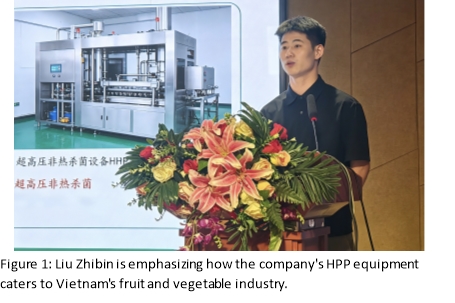
"Mature domestic production lines cannot simply be transplanted to Vietnam," he said. "The texture of tropical fruit pulp, factory utilities and the budgets of small and medium-sized processors all differ. Thousands of details have to be adjusted."
According to the company, the Vietnam-facing design includes new pressure multipliers, electromagnetic adsorption plugs, needle-type pressure relief valves, a high-pressure temperature detection system and fixed protective devices. The company said the equipment has been certified by industry bodies and the National Food Machinery Quality Inspection and Testing Center, and that its team holds 14 invention and utility model patents, nine software copyrights and more than 20 academic papers related to the technology.
The commercial pitch is aimed at a specific problem in Vietnam’s fruit economy: fruit that is too ripe, bruised or cosmetically imperfect often has little value if it cannot enter the fresh export chain. Qyncore Tech says its equipment and processing methods can turn some of that fruit into juice, puree or concentrate, giving processors a compliant channel for higher-value products.
The company said it has visited durian and mango growing areas in Vietnam’s central and southern coastal regions and has worked with local planting bases and fruit trading companies. Its services include equipment installation, process adjustment, operator training, quality-control training and what it describes as 48-hour on-site maintenance support.
The team’s longer-term plan is to build a demonstration model in Vietnam before expanding talks with producers and companies in other ASEAN fruit-growing countries, including Thailand, Indonesia and Malaysia. It is also discussing cooperation with Vietnamese universities in food safety, fruit and vegetable processing and joint talent training, according to the draft.
Liu described the project as both a business venture and an attempt to match Chinese agricultural research with practical overseas demand.
"Entrepreneurship is not only about building a company," Liu said. "It is also about using domestic hard technology to respond to real industrial challenges in Belt and Road countries."
For now, the project remains at the demonstration and market-building stage. Its broader impact will depend on whether Vietnamese processors can afford the equipment, whether the technology performs consistently under local production conditions and whether processed fruit products can win stable buyers in China and other markets.